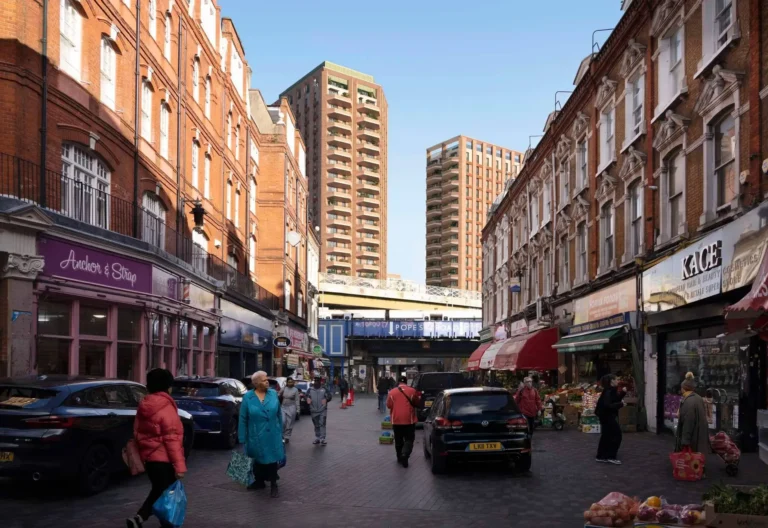
Revised proposals for a residential tower near Willesden Junction railway transport interchange were submitted to the Old Oak Park Royal Development Corporation (OPDC) in late 2025. The OPDC will determine the application, as with the previous consent, rather than the local district authority.
The Site (0.12 hectares / 0.29 acres) falls within the administrative boundaries of the Old Oak Common Opportunity Area (‘OPDC’), the London Borough of Hammersmith and Fulham (‘LBHF’), and the London Borough of Brent (‘LBB’).
The application was lodged on behalf of applicant Jeeran UK. Jeeran UK is a subsidiary of United Gulf Construction Company (UGCC), a construction and engineering company publicly listed on the Kuwaiti Stock Exchange. The applicant has commissioned architects HTA Design to produce design and access proposals for the site.
2 Scrubs Lane, located at the junction of Harrow Road and Scrubs Lane, was previously used as a church, nursery, and community space, which has since relocated off-site.
The site has consent from June 2018 for a scheme that includes a 20-storey residential tower, 2,300 sq ft of commercial space, a new church, nursery, and community facilities at Old Oak and Park Royal. It would have contained 85 new homes comprising one, two, and three-bedroom apartments. 35% will be affordable, with 12 apartments for London Living Rent and 16 for Shared Ownership.
Planning permission was granted in 2018 for a tall building, which expired in 2021. Fire safety regulations introduced in 2022 mean that it is no longer possible to deliver the previous plans.

The Site is 0.12 hectares (‘ha’) in size and is located at the eastern corner of Scrubs Lane (A219) as it joins Harrow Road (A404).
The surrounding area has both an existing industrial and commercial character. The area has a notably changing and emerging character that includes new residential developments and tall buildings that are located within the wider vicinity of the site.
The application seeks full detailed planning permission for a residential-led scheme comprising 418 co-living units, which are designed with a 100% single-aspect layout, supported by 886.8 sqm of commercial floorspace and 1,864.2 sqm of communal facilities.
In addition, the scheme aims to maximise active frontages along Scrubs Lane and Harrow Road, enhancing the streetscape and contributing positively to the local urban character.
As the site is situated within 600 meters of Willesden Junction Underground and National Rail station, as well as several bus stops, it has a Public Transport Access Level of 4, with a score of 3, which is where car-lite development is emphasised.
The proposal has been designed to form an emerald-shaped building with an octagonal form, which seeks to contribute “to a refined and slender appearance on the skyline”. The proposed materials take inspiration from the neighbouring buildings, reflecting the brick tones of the area. The palette consists of sandstone-coloured, light grit-blasted precast concrete, complemented by dark brown, light grit-blasted precast concrete, and finished with accents in chocolate brown PPC or paint.

The studio apartments have been designed to 2nd generation co-living standards in line with the GLA LPG 2024, prioritising a comfortable living experience that offers variety and choice. The standard rooms are provided with a bedspace, study, storage, kitchenette, and ensuite.
Given the aspirations for the area to be highly accessible to public transport networks and local services facilities, it has been agreed with the OPDC and Transport for London (‘TfL’) that the development will be car-free, except blue badge spaces.
Cycle parking for the development will be provided in the form of two-tier parking, standard and enlarged Sheffield standards, which are capable of accommodating 209 bicycles. Of the 209 spaces provided, it is proposed that 10 top-tier racks will be used to store the standard shared bicycles.
As set within the financial viability assessment, the scheme with £3.1m CIL and S106 contributions and the replacement community facilities creates a negative return. A summary of the viability results is set out in the table below.
The results show that the scheme, with c.£3.1 CIL and S106 contributions and the replacement community facilities, creates a negative return before the inclusion of any Payment in Lieu (PIL).
The appraisal forecasts: Revenues £98,294,924, Costs £113,596,534, and a negative return amount of £15,301,610, which is equivalent to 14.51%. On this basis, there is no requirement for the scheme to provide a PIL to comply with the relevant planning policies, which are subject to financial viability considerations.
Notwithstanding this, the Applicant has also confirmed that they are prepared to take an internal
commercial view on a range of factors to commit to a PIL of £2m. The Applicant will also
enter into early and late-stage viability reviews, which will enable the PIL to increase should delivery
of the scheme be delayed.