Proposals have been submitted on behalf of the applicant, Berkeley Homes (West London) Ltd (‘Berkeley’ or the ‘Applicant’), for a full planning application seeking permission for the redevelopment of the land in Motspur Park on the site of the decommissioned gasometer. The applicant appointed architects Maccreanor Lavington to produce design and access proposals for the site.
The 2.97ha Site sits across two administrative areas; the majority (2.83ha) is within the jurisdiction of Royal Borough of Kingston upon Thames (‘RBK’), with the northern access to the Site (0.14ha), to the north of Beverley Brook, contained within the London Borough of Merton (‘LBM’). As a result, this is a ‘cross-boundary’ scheme for which identical planning applications are being submitted to both RBK and LBM in accordance with
government guidance.
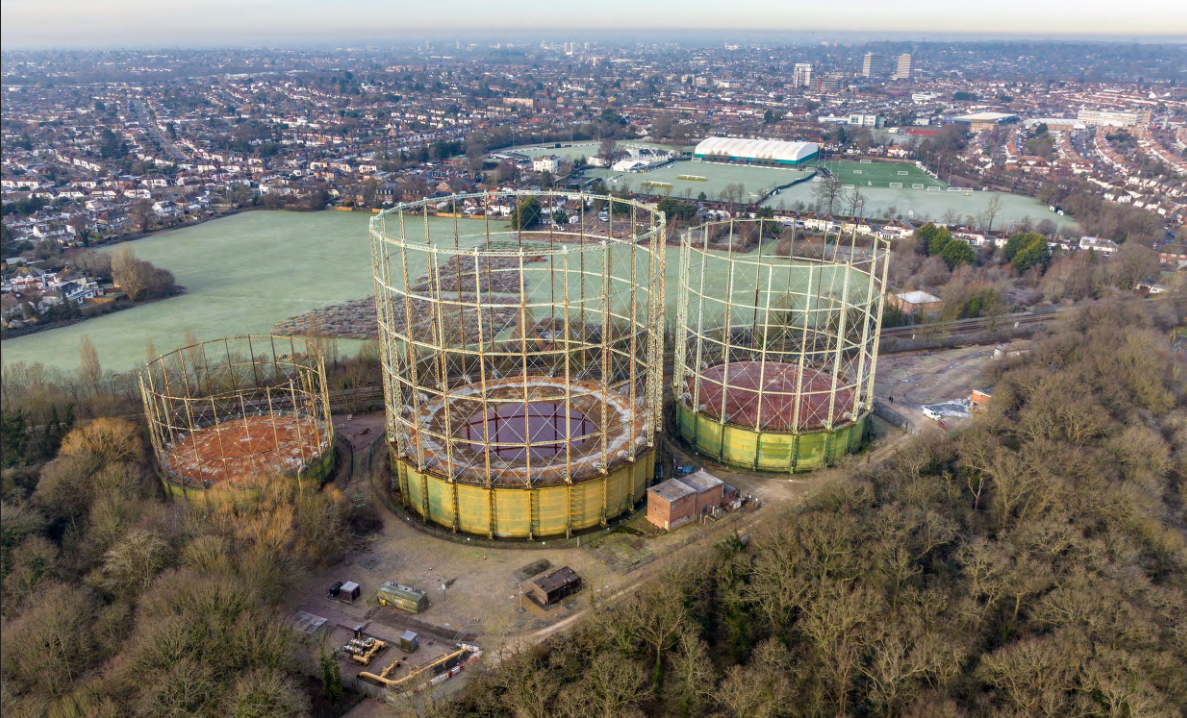
In 1924, the Wandsworth, Wimbledon and Epsom District Gas Company bought the land at Motspur Park to build the new gas holders to supply the rapidly expanding population of south-west London with gas. The three gas holders were then built in 1924, 1932, and 1954, and were used to store gas for distribution to local areas such as Kingston and Croydon until new methods of gas storage were introduced in the late 20th century. The gas holders have now stood redundant since approximately 2007, as SGN can store gas with more modern methods. SGN have owned the site since 2005 since the firms founding.
Following years of upgrading gas infrastructure, including the storage of gas in underground pipework, the Motspur Park gas holders were decommissioned by Ofgem in 2012, and they are now redundant. SGN is required by Ofgem to dismantle these and all redundant gasholders by 2029.
A comprehensive Statement of Community Involvement (SCI) accompanies this application. It records a three-phase, hybrid consultation programme (December 2024, March 2025, July 2025) combining in-person drop-in exhibitions at Shiraz Mirza Community Hall and Manor Park Hall with parallel online engagement.
Across the programme, there were 277 attendees at the events and 2,828 unique website visitors, supported by social media adverts generating 2,192 link clicks. 9,319 flyers were distributed across the catchment. In total, 1,206 pieces of feedback were received via online and paper forms, freepost, email, and phone. A dedicated email and freephone operated throughout, with all materials available online.
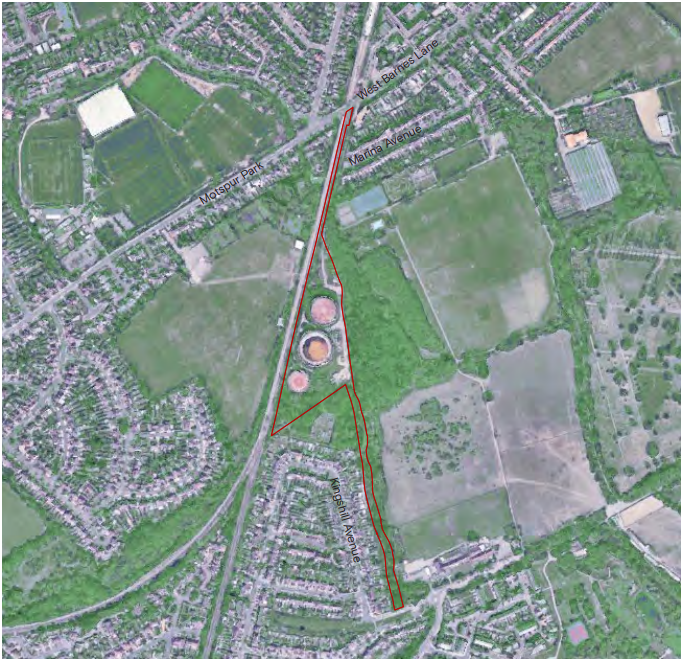
As the proposed homes would be delivered within the Royal Borough of Kingston upon Thames (‘RBK’), whilst a it is considered as an cross boundary scheme. We have chosen to focus on Kingston’s record on new housing supply.
Introduced in 2018, the Housing Delivery Test (HDT) is an annual measurement by the Government of housing delivery in each local planning authority area. The measurement identifies the number of homes required and the number of homes delivered over the preceding three years to calculate the percentage delivered.
The resulting percentage identifies if, and if so, what consequence would apply to the local planning authority. Where delivery falls below 75%, the presumption in favour of sustainable development
RBK has consistently and significantly under-delivered against the number of homes that it requires, with results continuing to worsen. RBK’s 2023 result placed it in the bottom 7% of worst performing LPAs nationally.
RBK’s latest Five-Year Housing Land Supply (5YHLS) and Housing Delivery Test (‘HDT’) position statement (March 2025) states that RBK has a 1.48-year deliverable supply of housing in the 2024/25 to 2028/29 period as of 1 March 2025
RBK’s housing delivery record is representative of the acute housing crisis that is being experienced across London. It has failed the Housing Delivery Test, and its 5YHLS position (less than 1.48 years) is dire. These factors mean that the NPPF paragraph 11 ‘tilted balance.’ applies.
The proposed development could deliver 586 new homes over 5 residential phases of development. This equates to 60% of a year’s worth of RBK’s housing requirement (London Plan target), and substantially more than the average number of homes RBK has delivered since 2019.
The Proposed Development will deliver 35 per cent affordable housing (by habitable room) and comply with the requirements of the London Plan Fast Track Route and those policies that remain up-to-date (London Plan H5).
The proposed affordable housing tenure mix provision, comprising 50% affordable rent and 50% shared ownership, accords with the London Plan tenure mix set out in Policy H6.
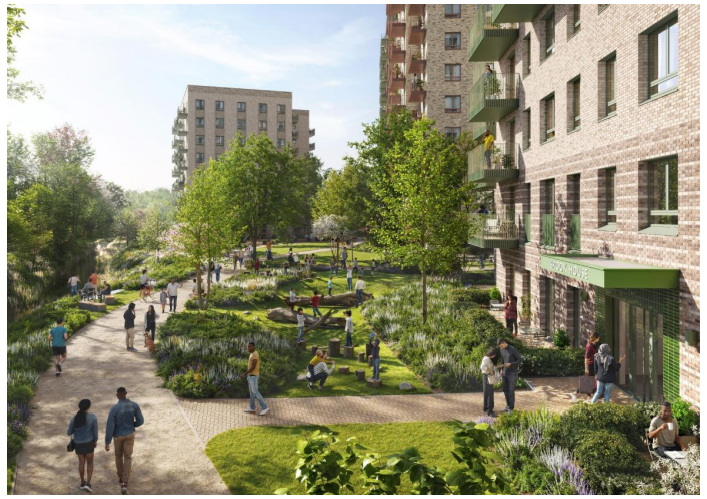
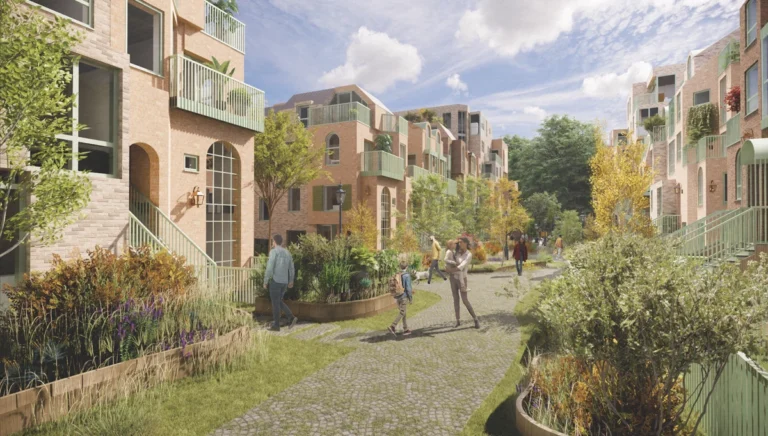
The layout is landscape-led. Built footprint is drawn to the western side against the railway, keeping the Beverley Brook as a continuous green corridor. This releases a largely car-free north-south route along the brook, and concentrates the development on previously developed land. Blocks are oriented east-west to maximise daylight and avoid north-facing single-aspect. Gaps between the buildings preserve sightlines to the brook and create east-west permeability.
It will deliver the opening up of the Site to public access for the first time in 100 years, providing a new north/south pedestrian and cycle route through a new public realm.
A total of 89 residential parking spaces are included within the Proposed Development. This equates to a parking ratio of 0.15, lower than the policy requirement in policy T6.1 of the London Plan.
Of the 89 car parking spaces proposed, 18 are blue badge spaces, equating to 3% of the total parking provision. Should an increased demand for blue badge spaces arise, there is potential for an additional 7% of spaces to be delivered beyond the occupation of the development.
Cycle parking will be London Plan and London Cycle Design Standards compliant, providing 1,035 long-stay cycle parking spaces for residents and 28 short-stay cycle parking spaces for visitors.
The proposed apartments will have access to either a private terrace, or balcony (6 sqm per dwelling). In addition, residential communal gardens are proposed across the masterplan.
The ground floor units will benefit from 152 sqm of private terraces, which are separated from the public realm through fencing and intentional planting.
Across the Site, the scheme benefits from 3,640 sqm of communal amenity, in the form of communal gardens and landscaped spaces, largely within proximity of the residential blocks. There is an additional, internal amenity space for the use of residents in the form of a ‘clubhouse’ of 252 sqm).
Simultaneously elsewhere with the borough, the same determining authority is also reviewing plans for up to 1,952 homes on a “grey belt” site in Chessington, one of the single largest housing applications submitted to the borough since it’s formation.